ROBOT MATCH
Not sure which robot you need? Let's find your match.
Tell us your plan, timing, budget and location. We'll recommend a robot from the public catalogue.
Find my robot
Unitree G1
SoftBank Pepper
EngineAI T800
1. What do you need a robot to do?
The most common mistake is falling for a robot on YouTube and then looking for something for it to do. Flip it around. Write down, in one sentence, what the robot should achieve.
If your goal is…
You're really asking for…
Start by looking at
🎉
More visitors, photos and buzz
A show and a photo moment
Small humanoid or robot dog
🎉
Greeting, directions, sign-ups
Information and lead capture
Promobot
🎉
A "wow" stage moment
Presence and height
Full-size humanoid
🦾
Moving boxes, totes or parts
Repeatable physical work
Industrial humanoid
🦾
Inspection rounds and patrols
Walking a route and collecting data
Industrial robot dog
🔬
Testing your own software or AI
Open, programmable hardware
Research (EDU) humanoid or dog
Then describe the setting: where the robot works, for how many hours, around how many people, and what "good" looks like at the end. That one paragraph becomes the brief you send operators (template below ).
Not sure robots are worth it for your use case? Read the evidence first: events , industry or research .
2. Which type of robot suits your job?
Almost every robot you can hire today falls into one of three groups.
Try them out in our simulator →
Swipe to compare all three types
A note on versions. Many robots come in several trims. A basic Unitree G1 is made for shows. The G1 EDU versions add developer access, and often better hands and more computing power. They're what labs want, and in our data they rent for about three times as much. Always check which version a quote is for.
Which robots should you shortlist?
We compared the robots in our database on what they can do, how easy they are to book and what they cost to rent. These are the ones we'd shortlist. Top picks are our broadest recommendations, Editor's picks suit specialist jobs, and Hard to come by marks less commonly listed industrial models.
Small humanoids
The crowd-pullers. Light enough to roam a hall, agile enough to dance, box and do kung fu.
Best for: trade shows, launches, content
Unitree G1
The humanoid behind the Spring Festival Gala and America's Got Talent performances. It's listed in more countries than any other robot in our database, so it's the easiest humanoid to find near you.
Loading catalog traits…
Compare robot →
Best for: tighter budgets, parties, retail
Unitree R1
Unitree's lightest, cheapest humanoid, launched at $5,900. Smaller and shorter-running than the G1, but it still stops people in their tracks.
Loading catalog traits…
Compare robot →
Full-size humanoids
Adult height makes the moment. For keynotes, reveals and receptions where the robot needs to hold a room.
Best for: receptions, keynotes, greeting VIPs
AGIBOT A2
A full-size service humanoid built to greet, talk and guide. It suits premium lobbies and stage reveals, and it rents for less than you might expect in markets like Dubai.
Loading catalog traits…
Compare robot →
Best for: stage shows, combat demos, big reveals
EngineAI T800
Tall, heavy and built for high-energy moves, with the longest run time of any full-size humanoid in our top picks. Book it when the robot is the headline act.
Loading catalog traits…
Compare robot →
Greeters and promobots
Less spectacular on camera, but unbeatable for directions, menus, QR codes and sign-ups, and they run all day.
Best for: store openings, lobbies, lead capture
SoftBank Pepper
The robot behind the best-known retail results: 70% more foot traffic and six times the sales of featured products in a store pilot. A chest screen, conversation and an all-day battery.
Loading catalog traits…
Compare robot →
Best for: greeting, directions, shopping centres
Promobot V4
A visitor-facing wheeled robot with a screen for information and guidance. Its listed eight-hour battery life suits longer event days.
Loading catalog traits…
Compare robot →
Research robots
Open, programmable hardware for labs, theses and competitions. Always confirm the developer (EDU) version.
Best for: locomotion and reinforcement-learning research
EngineAI PM01
A light, agile humanoid aimed at developers, fast enough for serious locomotion work and small enough for a lab.
Loading catalog traits…
Compare robot →
Best for: hands, interaction and embodied-AI research
AGIBOT X2 Ultra
The upgraded X2 for research teams who need more capability in a compact, lab-friendly body.
Loading catalog traits…
Compare robot →
Robot dogs
Consumer dogs are for fun and social clips. Industrial dogs walk inspection routes. They are very different machines.
Best for: mall events, parties, photo spots
Unitree GO2 Air
A playful crowd-pleaser for events and social clips, compact enough to fit into many venues.
Loading catalog traits…
Compare robot →
Best for: plant rounds, thermal and acoustic checks
Boston Dynamics Spot
The proven inspection robot. At AB InBev it found about 150 faults in six months and paid back within a year.
Loading catalog traits…
Compare robot →
Industrial humanoids
For tote moving, part loading and factory pilots. Ask for a monthly quote, not a day rate.
Best for: factory pilots, multi-shift work
UBTECH Walker S2
Swaps its own battery in about three minutes, so it can keep working across shifts.
Loading catalog traits…
Compare robot →
Best for: tote handling, warehouse pilots
Agility Digit
The humanoid behind the first formal robots-as-a-service deal, with GXO, moving totes onto conveyors.
Loading catalog traits…
Compare robot →
Specs from the RoboHours catalogue, September 2026. Battery life is typical run time per charge and depends on the routine.
3. What should you decide before requesting robot rental quotes?
Operators can only quote well if you know these answers. You'll also be able to compare quotes fairly.
What should people (or the robot) actually do? Watch, play, get information, move items, inspect, or run your code? This decides the robot type.
Where will it work? Floor type (carpet, tiles, concrete, outdoor), space per robot, ramps or stairs, crowd density, noise, Wi-Fi and power. A 3 × 3 m booth is tight for a humanoid doing kicks. A dusty warehouse is no place for a show robot.
For how long? Hours per day and number of days. Most small humanoids run about 2 hours per battery, industrial models 2–4 hours, and a few can swap their own batteries. Plan breaks, spares or a second robot.
Does it need to talk, or connect to anything? Speech in several languages, a branded screen, a link to your booking or warehouse software, or low-level access for your own code. Each one narrows the list.
What's the all-in budget? Include the operator, transport, set-up, branding, rehearsal and insurance, not just the robot's rate.
4. How much does robot rental cost in your location?
Most operators quote by the day, and many include an operator. To make prices comparable, RoboHours converts every quote into a robo-hour : one robot working for one hour. Day estimates assume an 8-hour working day. Historical price examples in this guide are dated September 2026; the live rate tables below use current published catalog estimates.
Short-term vs. long-term. Most quotes in our database are for short bookings (a day or a few days), often with an operator on site. Long-term contracts, such as a monthly robots-as-a-service deal for a factory or warehouse, are priced very differently and usually work out much cheaper per hour. Don't judge a six-month pilot by an event day rate.
Why does the same robot cost different amounts in different cities?
Where you book changes the price more than almost anything else. Here are the lowest short-term daily equivalents for a standard Unitree G1 in the markets we currently track, calculated from hourly, daily, or weekly source quotations—not necessarily a directly published daily rate. Weekly quotations are converted using the catalog basis of 8 hours per day and 168 hours per week; monthly quotations are excluded.
Loading current exchange rates…
Prices differ because of:
Supply. More robots and operators nearby means more competition. In China, where supply is deepest, CNN found humanoids for hire from 3,500 yuan (about $517) a day , including shipping and an operator.
Distance. If the nearest robot is in another country, you pay for shipping, travel and the operator's time on the road.
Operator costs. Local wages and insurance feed straight into the day rate.
Peak dates. Major trade-show weeks and holidays book out early and cost more.
What's included. One quote might include branding, transport and a back-up robot. Another might not.
Tip: if you can be flexible on location, for example a touring show or a pilot you can run at another site, it may pay to book from a cheaper market and pay for transport.
What do different robots cost to rent in Dubai?
Here's what currently listed robots cost in one market, Dubai, when public estimates are available:
Loading current exchange rates…
See live prices for your city in the Robot Comparison tool →
5. What should a robot rental quote include?
Two quotes with the same headline price can be very different deals. Ask every operator whether the price includes:
Red flags
🚩
No clear answer on insurance.
🚩
A price for “the robot” without its exact model and version.
🚩
No training when you rent the robot on its own.
🚩
No back-up plan if the robot breaks down.
🚩
A basic scripted robot passed off as an advanced humanoid. Ask for the model and a demonstration of what it can actually do.
Should you rent a robot with an operator?
Most bookings include a trained operator who drives the robot, runs the routines and keeps people safe. Some operators also rent out the robot on its own. That's cheaper and can work well, if you know how to use it.
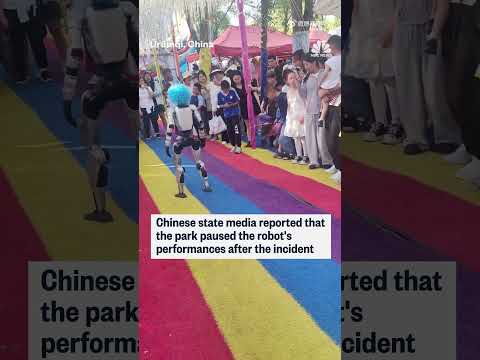
Remember what you're handling. A Unitree G1 weighs about 35 kg and its joints are strong enough for kicks and flips. In June 2026, a G1 performing a kung fu routine at a public demo in Xinjiang, China, kicked a child in the stomach . Reports said the child was not seriously injured.
▶
▶ Video: a humanoid robot kicks a child during a public performance in China (NBC News).
If you rent the robot only:
Get trained first. Ask for a handover session, and practise the controls and the emergency stop before the day.
Keep a safety zone. No one inside the robot's range during kicks, flips or fast moves, especially children.
Know your liability. When you drive the robot, damage and injuries may be on you. Check that your insurance covers it, and read the rental terms.
Have a plan B. Know who to call if it falls, freezes or runs out of battery mid-show.
If in doubt, book with an operator. For a first booking, it's almost always worth it.
6. How do you write a clear robot rental brief?
Copy this, fill it in and send the same brief to every operator. You'll get quotes you can actually compare. (Or send one request to several operators at once through RoboHours.)
Purpose: (e.g. draw visitors to our booth / move totes between two stations / test our walking controller)
Robot type or model in mind: (or "open to suggestions")
Location and venue: city, indoor/outdoor, floor type, space available
Dates and hours: days, hours per day, set-up time available
People nearby: expected crowd size, or staff on site
Must-haves: speech/languages, branding, payload, software access, connectivity
Budget range: all-in
Success looks like: (e.g. 500 visitors scanned / 2,000 totes moved / 20 test runs completed)
7. Should you rent or buy a robot?
For most people, most of the time: rent first. Robots are one of the fastest-depreciating things you can buy. Here's why.
Robots are improving fast. Unitree alone has launched three humanoids in roughly two years: the H1, the G1 in 2024 at about $16,000 and the R1 in 2025 at just $5,900. These launch prices are shown as of September 2026. A robot bought today may be outclassed, and cheaper, within a year.
Real use exposes weaknesses you can't see in a demo. Figure's humanoids worked 10-hour shifts at BMW's Spartanburg plant for 11 months and loaded over 90,000 parts. The forearm turned out to be the main point of failure , so Figure redesigned it for the next model. If you owned the old generation, you'd be stuck with it.
Even the big players avoid owning. GXO, one of the world's largest logistics firms, deployed Agility's Digit humanoids under a robots-as-a-service deal, so it could use the robots without owning them and scale up as needed.
Analysts say: pilot first. Gartner expects fewer than 20 companies to have humanoids in full production for manufacturing and supply chain by 2028. It advises pilots aimed at specific bottlenecks before any big commitment.
What does it really cost to own a robot?
The sticker price is only the start. Here's what a purchase really involves compared with a rental.
Cost
If you buy
If you rent
Hardware
Full price up front, and EDU or pro versions cost far more than the base model
Included
Depreciation
Entry prices fell ~63% in a year; resale value drops fast
The operator's problem
Operator & training
Your staff, your time, your learning curve
Usually included
Repairs & spare parts
You pay, and wait for parts
Operator repairs or swaps the robot
Insurance & liability
You arrange and pay
Often included. Check the quote
Transport & storage
Flight cases, a van, a storeroom
Delivered and collected
Newest model
Stuck with what you bought
Book the latest each time
Rent when…
Consider buying when…
It's a one-off or seasonal need (events, launches, open days)
You'll use it most working days for years
You're testing whether robots work for your task
A pilot has already proven the return
You need several robots for a short time
You have trained staff to run and repair it
You want the newest model each time
The model is mature and unlikely to change much
You don't want to handle transport, repairs and insurance
You have space, insurance and a maintenance plan
A simple rule of thumb: add up the rental days you'd realistically need in a year. Compare that with the purchase price plus maintenance, insurance, storage, an operator's time, and the robot's likely resale value in 12–18 months. For occasional use, renting wins by a long way.
Running a factory pilot? Ask for a monthly robots-as-a-service quote. It's priced very differently from an event day rate.
8. How can you test a robot before committing?
A trial is only useful if you decide up front what you're measuring.
Use case
Measure
Example trial
🎉
Events & promotion
Visitors, QR scans, sign-ups, social posts, sales of featured products
One trade-show day: a 5–8 minute show every hour, roaming between shows, photo spot always live, results checked every evening
🦾
Industry & labor
Tasks per hour, error rate, human interventions per shift, uptime
Two weeks on one repetitive task, e.g. moving totes between two points, compared against the manual baseline
🔬
Research & academia
Test runs completed, success rate on real hardware vs simulation, data collected
A 2–6 week block around a paper deadline or a thesis milestone, with repair terms agreed in advance
At the end, compare the results, staff feedback and total cost against the goal you wrote in step 1. Then decide whether to repeat, scale up, try another robot, or stop.
Practical checks for any trial:
Space and safety: agree a working zone and keep people at a safe distance, especially from walking robots.
Floors: share photos of carpets, ramps, cables and slippery surfaces in advance.
Connectivity: ask what network the robot needs, and whether it can run offline.
Noise: voice features struggle in loud halls and factories. Plan for a screen or a microphone instead.
Supervision: most robots today need a trained operator nearby. That's normal. Make sure one is included.
FAQ
How much does it cost to rent a robot?
Rental estimates vary by robot, location, dates, booking length and what is included. Browse the public catalogue for location-specific published starting estimates; they are estimates, not final prices. The rental operator confirms the final quote, availability, minimum booking and inclusions. Where a day estimate is shown, it is based on an 8-hour workday. Check live prices for your city.
What is the best robot to rent?
For events, the Unitree G1 is our top all-round pick, with the Unitree R1 as the best-value option, the AGIBOT A2 or EngineAI T800 for stage presence, and SoftBank Pepper as the best greeter. For research, we pick the EngineAI PM01 and AGIBOT X2 Ultra. For inspections, Boston Dynamics Spot. See all top picks.
Is it better to rent or buy a robot?
For occasional use, testing or the newest models, renting can reduce the upfront commitment. Robot purchase prices and configurations can change, so confirm current costs directly with the manufacturer or seller. Buying makes sense when a pilot has proven the return and you'll use the robot regularly. See the full comparison.
What is a robo-hour?
One robot working for one hour. RoboHours converts every operator's quote into robo-hours so you can compare offers fairly.
Why does the same robot cost so much more in some cities?
Location-specific published starting estimates can differ because of local supply, shipping distance, operator support, insurance and dates. Compare the estimate for the location you need and confirm the complete price and terms in the rental operator’s quote. See prices by market.
Do rented robots come with an operator?
Usually, yes. Some operators also rent the robot on its own, which is cheaper but makes you responsible for driving it safely. Only do that if you've been trained. See what to check.
How far ahead should I book?
As early as you can, ideally several weeks ahead for busy periods. Custom routines, branding and industrial set-ups need extra lead time.
What's the difference between a basic and an EDU robot?
EDU (education/research) versions give developers access to program the robot and may have different hardware configurations. Rental estimates vary by model and location; confirm software access, configuration and final pricing with the rental operator. You only need one if you'll run your own software.